
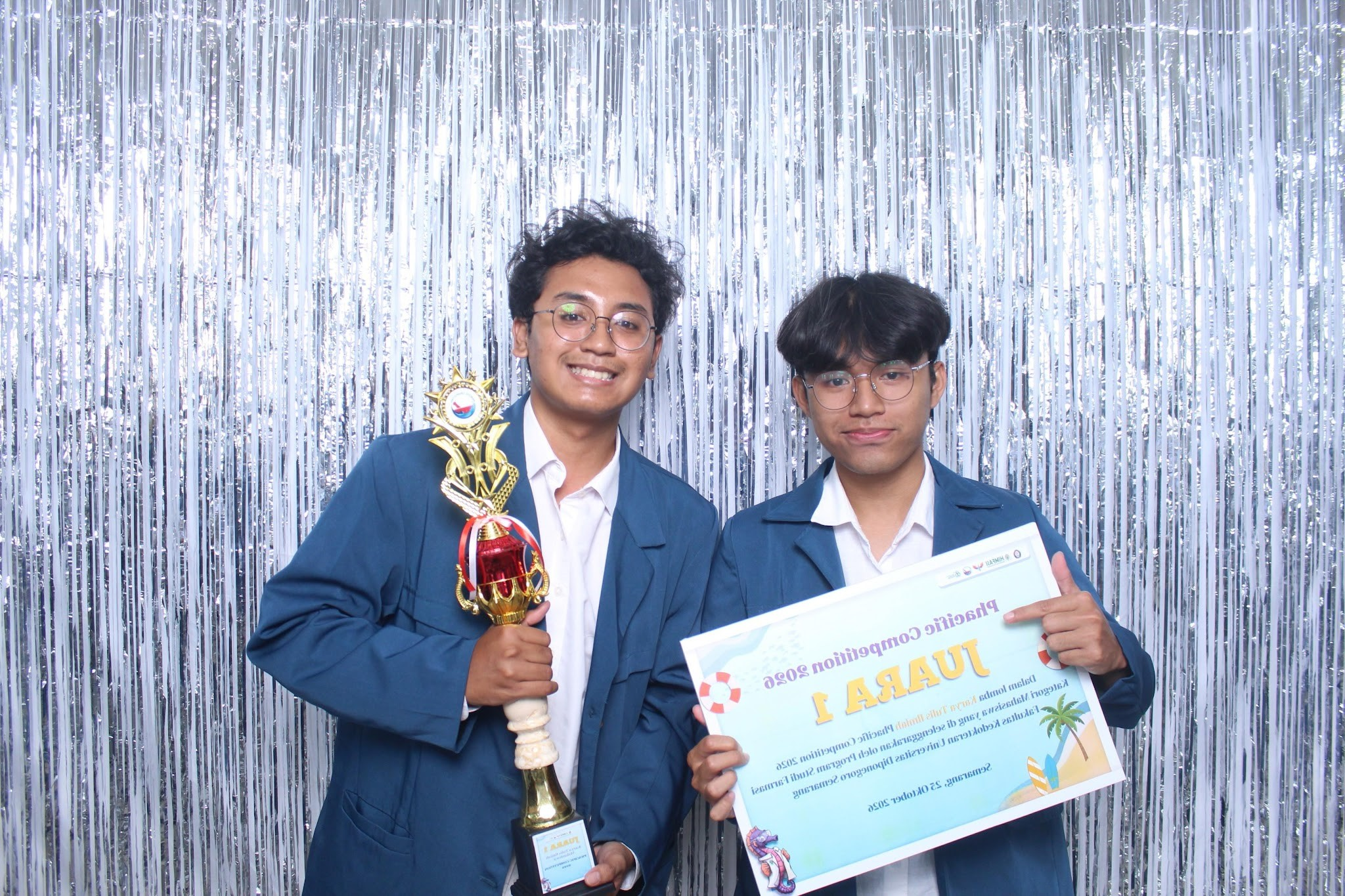
The idea of utilizing marine sponge metabolites as candidates for Alzheimer’s disease therapy development has brought FF students to UNAIR national recognition. The UNAIR Team won 1st place at PHACIFIC 2026, held on Sunday, October 25, 2026, at the Pharmacy Study Program, Faculty of Medicine, Universitas Diponegoro.
The team consisted of Delsyad Muhammad Koosha Alzer and Putri Aliyatuzzahra from FF UNAIR, and Bayu Cahyo Bintoro from the Faculty of Dental Medicine (FKG) UNAIR, under the supervision of apt. Suciati, S.Si., M.Phil., Ph.D. In the competition, they presented research on the potential of metabolites from the marine sponge Leucetta sp. as candidate acetylcholinesterase (AChE) inhibitors for the development of Alzheimer’s medication.
Exploring the Potential of Marine Sponges for Alzheimer’s
Delsyad, the team leader, explained that the idea stemmed from the continuing challenges in developing Alzheimer’s therapies. This situation prompted the team to explore marine natural resources as a potential source of compound candidates for drug development.
“We see that marine biodiversity has enormous potential to be developed in the health sector. Therefore, we tried to explore marine sponge metabolites as one candidate that has the potential to be further developed in Alzheimer’s research,” he said.
The research was conducted using a computational approach to help select compounds with potential interaction with targets involved in Alzheimer’s disease. Based on the analysis, one candidate compound was identified that showed fairly promising and stable results for development in subsequent research stages.
Nevertheless, Delsyad emphasized that the findings remain at an early stage. Further research through experimental testing is still required to confirm their potential and safety before they can be directed toward becoming drug candidates.
Rooted in Health Challenges
Delsyad explained that the choice of Alzheimer’s as the topic was motivated by the need for the development of continually evolving therapeutic alternatives. On the other hand, Indonesia’s rich marine biodiversity also opens great opportunities for exploration as a source of bioactive compounds.
Through this research, the team hopes that the use of computational technology can help make the early process of searching for drug candidates more focused and efficient.
“We hope this research can serve as one of the initial steps in exploring the potential of Indonesian marine natural materials for drug development. Of course, further research stages are still needed so that the results can be developed further,” he explained.
At the end, Delsyad and the team encouraged students to dare to develop ideas based on problems with real impact while remaining grounded in strong scientific foundations.
“Start from problems that have real impact, then look for solution opportunities that can be developed. Don’t be afraid to try new approaches, but make sure the idea has a scientific basis and can be accounted for,” he concluded.


