
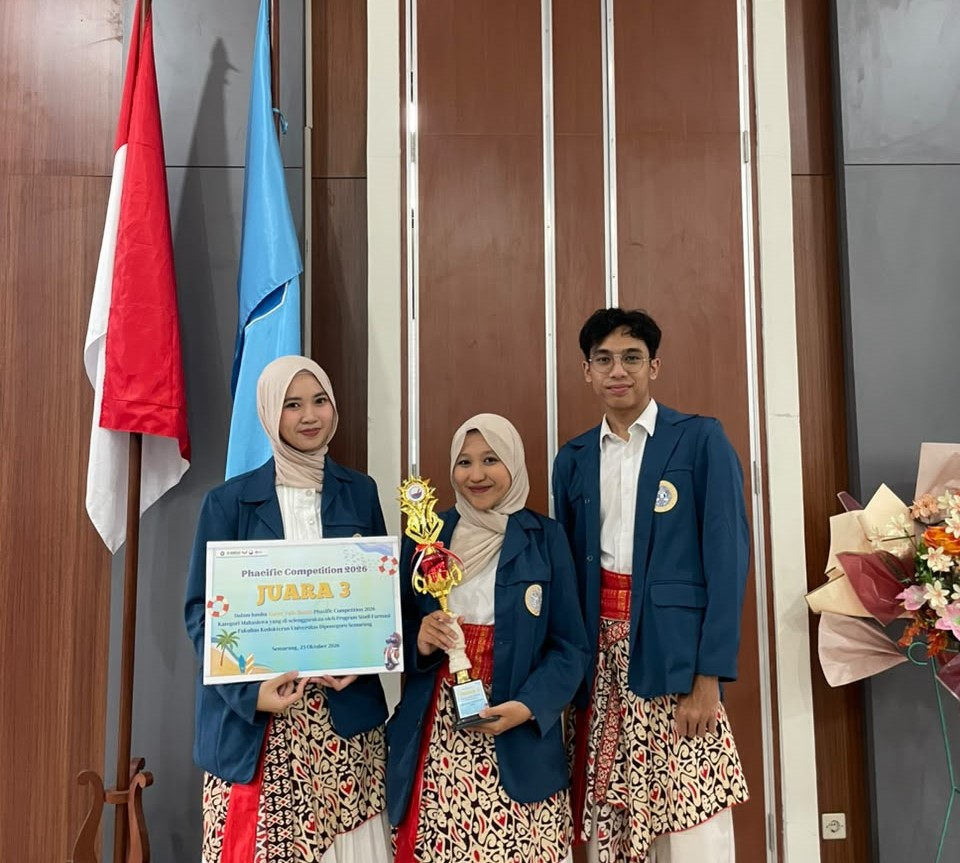
Three students from the FF UNAIR achieved 3rd place in the Scientific Paper Competition (LKTI) at the Pharmacy Scientific Competition 2026 organized by Universitas Diponegoro. The achievement was announced by the committee on October, 25, 2026.
The team, consisting of Nayesha Desta Kirania (2024), Miftakhu Rahma Wardhani (2023), and Vittorio Xavier Leandra Sangalang (2024), presented an innovative idea in the field of bone tissue engineering through a scientific paper titled ‘Self-Powered Piezoelectric Scaffold Based on Janitor Fish (Pterygoplichthys pardalis) Biomineral for Guided Bone Regeneration: Integration of Nanofabrication and Mechanotransduction.”
The paper addresses critical-sized bone defects resulting from trauma or tumors, which remain a challenge in the medical field. One approach used to address this problem is Guided Bone Regeneration (GBR), a bone regeneration procedure that uses a membrane as a barrier to support the formation of new bone tissue. However, commercially available GBR membranes are generally still passive, so their biological effectiveness can vary.
Building on this issue, the FF UNAIR student team developed the idea of a self-powered piezoelectric scaffold inspired by natural bone’s ability to generate micro electrical signals when subjected to mechanical load. These signals have the potential to stimulate cell activity and support bone regeneration without requiring an external power supply.
The innovation utilizes hydroxyapatite (HA) extracted from the bones of janitor fish (Pterygoplichthys pardalis), an invasive species found in Indonesia. Utilizing this biomineral represents an attractive approach to developing biomedical materials while increasing the practical value of resources that have otherwise posed environmental problems.
In the research design, hydroxyapatite was obtained through a series of stages, including cleaning, drying, de-medullation, chemical purification, and calcination at 1,000°C for 1.5 hours. The resulting HA powder was then sieved to a particle size of 37–44 micrometers and combined with the piezoelectric polymer P(VDF-TrFE).
This material combination was then fabricated using electrospinning technique to form a nanofiber structure (nano-scaffold) designed to resemble the bone extracellular matrix. Material characterization was carried out through several methods, including X-Ray Diffraction (XRD), Fourier Transform Infrared Spectroscopy (FTIR), Scanning Electron Microscopy (SEM), and Energy Dispersive X-ray Spectroscopy (EDS).
The characterization results presented in the paper showed the formation of a hydroxyapatite phase with a hexagonal apatite structure, homogeneous rod-shaped powder morphology, and the presence of trace ions such as sodium (Na), magnesium (Mg), and silicon (Si). These components are important aspects to be further examined in developing biomimetic materials that support the bone regeneration environment. Meanwhile, mechanical testing using a Universal Testing Machine (UTM) and piezoelectric testing were aimed at evaluating the material’s characteristics in generating responses to mechanical stimulation.
The integration of hydroxyapatite from janitor fish biominerals with piezoelectric polymers through nanofabrication offers the potential for developing economical and more environmentally friendly bioactive scaffolds. This approach is expected to serve as a foundation for further research on bone regeneration materials capable of combining electroactive stimulation and osteoinductive properties.
Achieving 3rd place in the Pharmacy Scientific Competition 2026 is a proud accomplishment for FF UNAIR students. This achievement also demonstrates students’ contribution in developing scientific ideas that integrate pharmaceutical science, materials engineering, and the utilization of local resources to address health challenges.
Beyond strengthening the research and innovation culture within higher education, this work also aligns with Sustainable Development Goals (SDGs) 3: Good Health and Well-being, through the development of innovative approaches in healthcare, and SDG 9: Industry, Innovation, and Infrastructure, through the exploration of nanofabrication technology and biomedical material development. The use of biominerals from an invasive species also relates to SDG 12: Responsible Consumption and Production, through efforts to sustainably increase resource value.


