
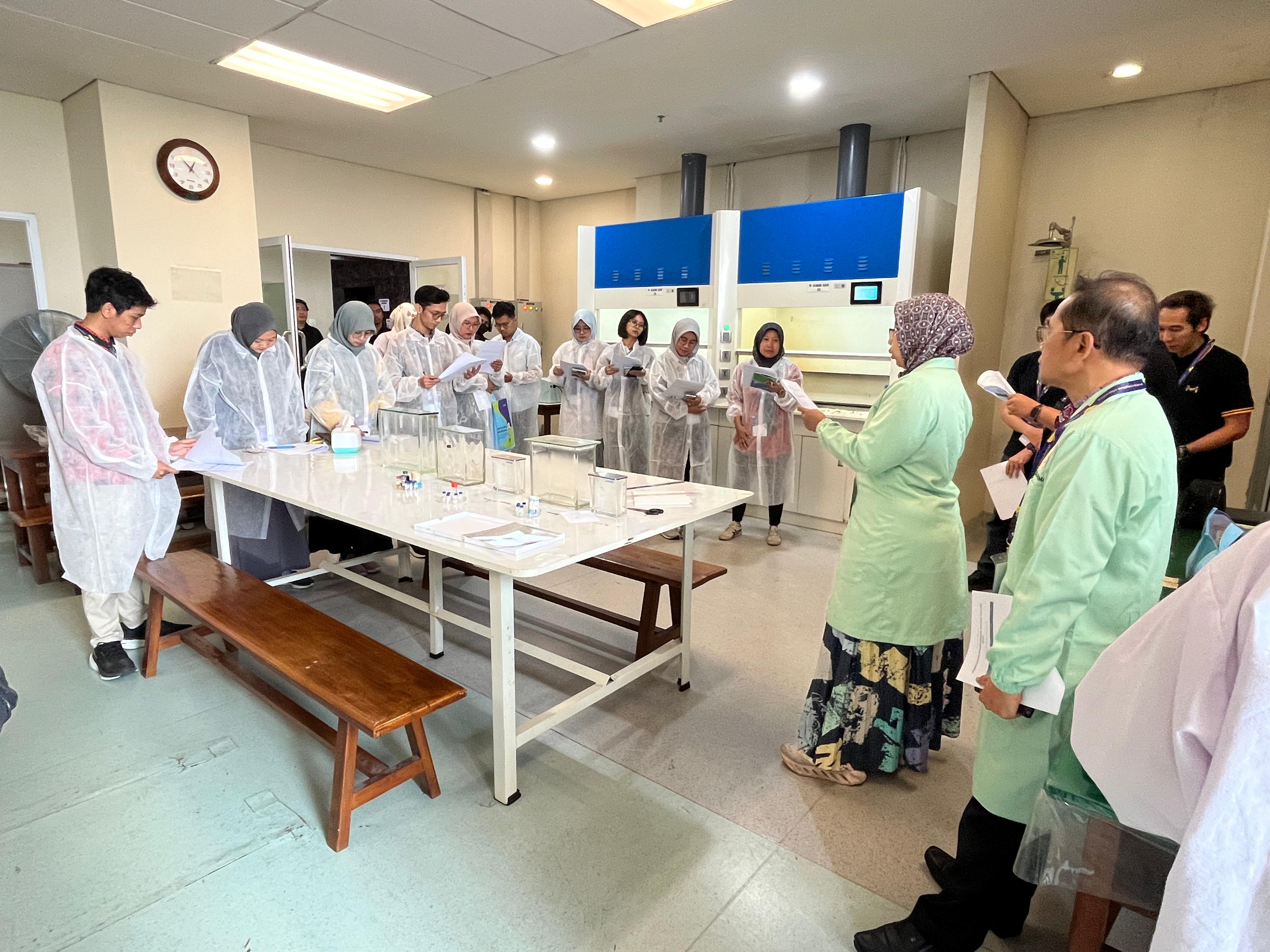
The Pharmaceutical Analytical Development Research Group of FF UNAIR, together with the UNAIR Testing Service Unit and PT Merck, organized the “Analytical Chemistry Workshop: Stepping into the Future of TLC” on October, 23, 2026, at the Main Conference Room of the Nani Building, UNAIR. The activity combined presentations from two speakers with hands-on practice using TLC Explorer for caffeine analysis in coffee.
Workshop participants came from the pharmaceutical industry as well as academics and researchers from Universitas Airlangga (UNAIR), Universitas Brawijaya (UB), Universitas Hang Tuah (UHT), Institut Teknologi Sepuluh November (ITS), The National Research and Innovation Agency (BRIN), Universitas Muhammadiyah Malang (UMM), Institut Ilmu Kesehatan (IIK) Bhakti Wiyata Kediri, and UNM. The participation of attendees from various institutions made this activity a space for learning and experience exchange in laboratory analysis related to TLC applications.

The two speakers were Prof. Dr. apt. Mochammad Yuwono, MS. from FF UNAIR, and apt. Annas Trisaksono, S.Si., Sales Specialist at Merck Life Science Indonesia. The presentation session provided an introduction to thin-layer chromatography and supporting analytical technologies.
Thin-layer chromatography (TLC) is a method for separating components within a mixture. Each component moves at a different distance on the plate due to differences in its interaction with the plate layer and the developing solvent.
In this workshop, coffee was selected as the practice sample. Using a material close to everyday life helped participants understand how TLC applies to observing the components of a product.
After the presentation session, participants took part in direct hands-on practice. The practice included preparing coffee samples, preparing the developing solvent, spotting caffeine standards and samples, and developing TLC plates.
Participants then learned how to use TLC Explorer to observe separation results. Sample profiles were compared with the caffeine standard as part of learning how to read and interpret analytical results.

One parameter studied was the Rf value, which is the ratio of the distance traveled by a spot to the distance traveled by the solvent front from the starting point. A matching spot position or Rf value may serve as an initial indication of the presence of caffeine, but it is not sufficient to confirm its identity or concentration.
The practice also emphasized the importance of precision at every stage. Sample preparation, spotting technique, and plate development conditions must be carefully controlled so that separation results can be properly compared.
The gathering of participants from industry, higher education, and research institutions provided opportunities to share experiences regarding analytical needs in each respective work environment. The combination of materials and practice gave participants space to connect foundational knowledge with laboratory instrument use.
Through this workshop, FF UNAIR and Merck Life Science Indonesia hope to strengthen participants’ understanding and skills in TLC-based analysis. Collaboration aligned with SDG 17 is also expected to open opportunities for joint activities supporting competency development in analytical chemistry.


