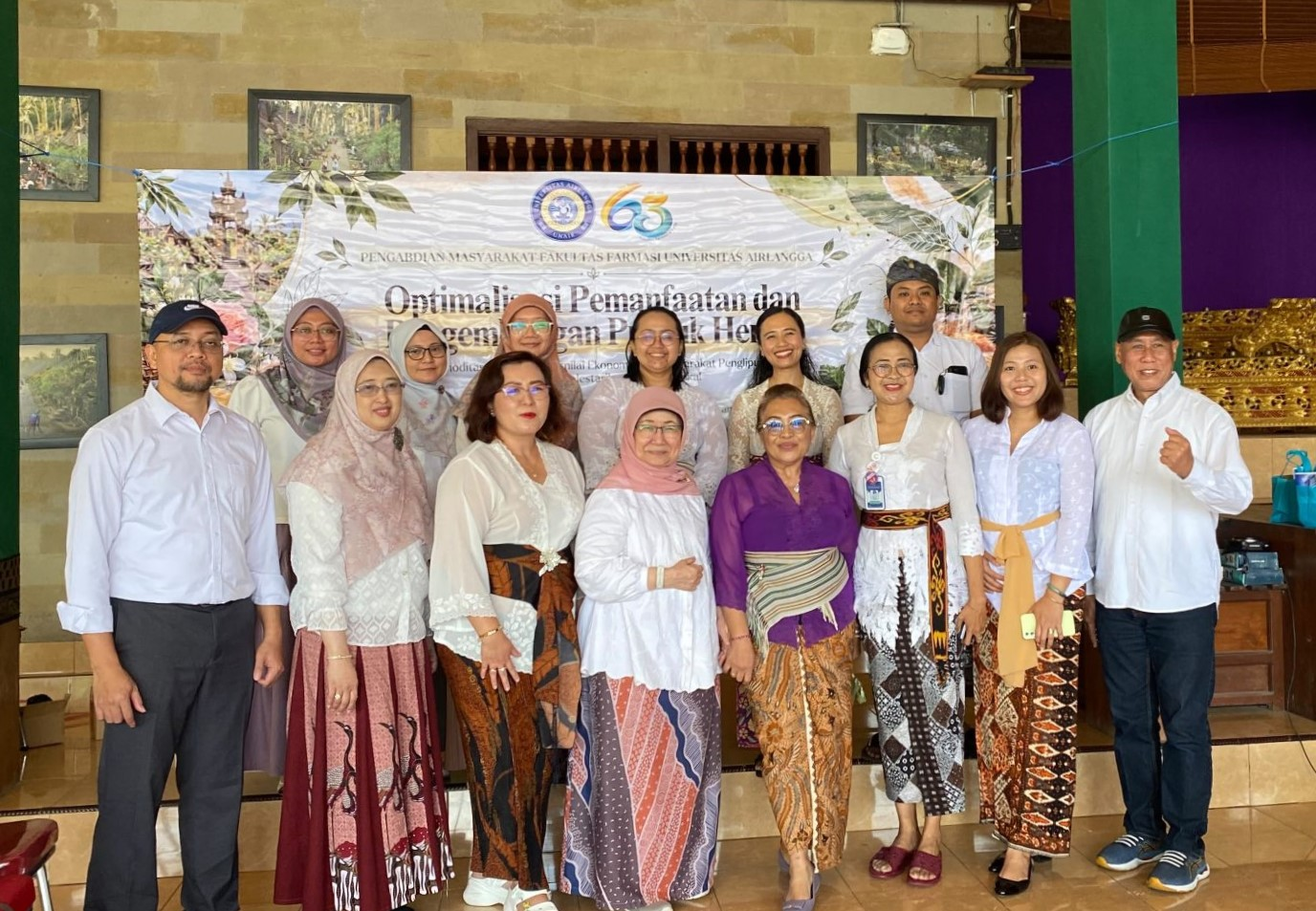
FF UNAIR continues to strengthen its contribution to community empowerment through community service activities. This time, FF UNAIR conducted a community service program in Penglipuran Village Bali, on October 24, 2026. The activity carried the theme “Optimizing the Utilization and Development of Herbal Products as Economically Valuable Health Commodities for the Penglipuran Community Bali, in Efforts to Preserve Local Wisdom.”
The activity, led by Prof. apt. Tutik Sri Wahyuni, M.Si., Ph.D., was attended by 30 participants from Youth Organizations (Karang Taruna) and Micro, Small, and Medium Enterprise (MSME) actors. Held at the Penglipuran Village Hall, the activity was structured as a series of education and practice sessions aimed at improving the community's knowledge and skills in processing natural materials into herbal products with added value.
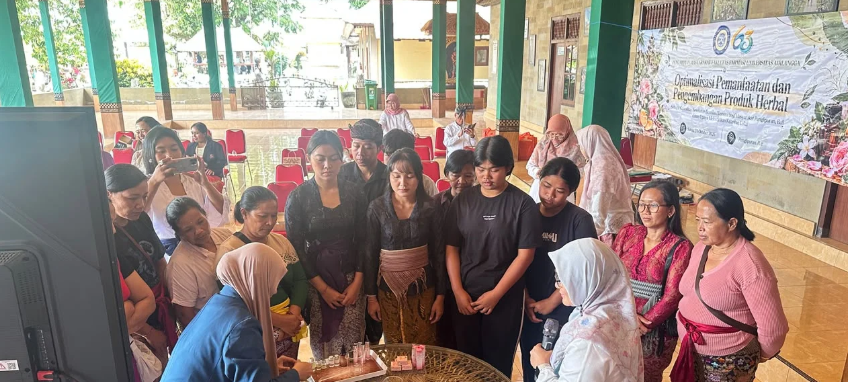
One of the main agendas was a material presentation and hands-on practice in making aromatherapy products, delivered by apt. Suciati, S.Si., M.Phil., Ph.D. In this session, participants were introduced to making solid perfume and aromatic roll-on aromatherapy. Both products are practical in form and have potential to be developed into flagship products based on local natural ingredients.
Through this practical session, the community not only gained knowledge about the production process but also an overview of the opportunities for developing aromatherapy products as business commodities. The utilization of natural materials into products with practical and market value is expected to open new economic opportunities for the local community.
In addition to aromatherapy product development, participants were also introduced to distillation technology through an explanation of how natural materials are processed to obtain essential oils. As a form of support for the sustainability of the activity, FF UNAIR also handed over a distillation apparatus to the Penglipuran Village community. This technology is expected to be utilized to process aromatic plant potential into essential oils, which can then be used as raw materials for fragrance and aromatherapy products.
The activity also paid attention not only to production aspects but also to product safety, quality, and legality. Participants received an explanation of regulations and registration for processed food and herbal medicines, including the certification and licensing process through the National Agency of Drug and Food Control (BPOM). This material was delivered by the Head of the BPOM Certification and Information Communication Team.
In the presentation, participants were given an understanding of the importance of recognizing product categories, meeting safety and quality requirements, including appropriate information on labels, and following licensing provisions based on the type of product to be marketed. This knowledge serves as an important foundation for MSME actors to develop herbal-based businesses more professionally and in compliance with applicable regulations.
Through this series of education, practice, technology introduction, and regulatory understanding support, FF UNAIR hopes that the Penglipuran Village community can increasingly optimize the utilization of natural resources in their surroundings. Development of herbal products supported by technology and understanding of safety standards is expected to improve product competitiveness and open opportunities for strengthening the community's economy.
Furthermore, this activity is also part of efforts to preserve and safeguard local wisdom through the productive and sustainable use of natural resources. This initiative aligns with the commitment to achieving the Sustainable Development Goals (SDGs), particularly SDG 8 on Decent Work and Economic Growth, SDG 9 on Industry, Innovation and Infrastructure, and SDG 12 on Responsible Consumption and Production.
Thus, this community service activity not only serves as a means of transferring science and technology from higher education to the community, but also as a concrete step in promoting economic independence based on local potential without abandoning the cultural values passed down through generations.