
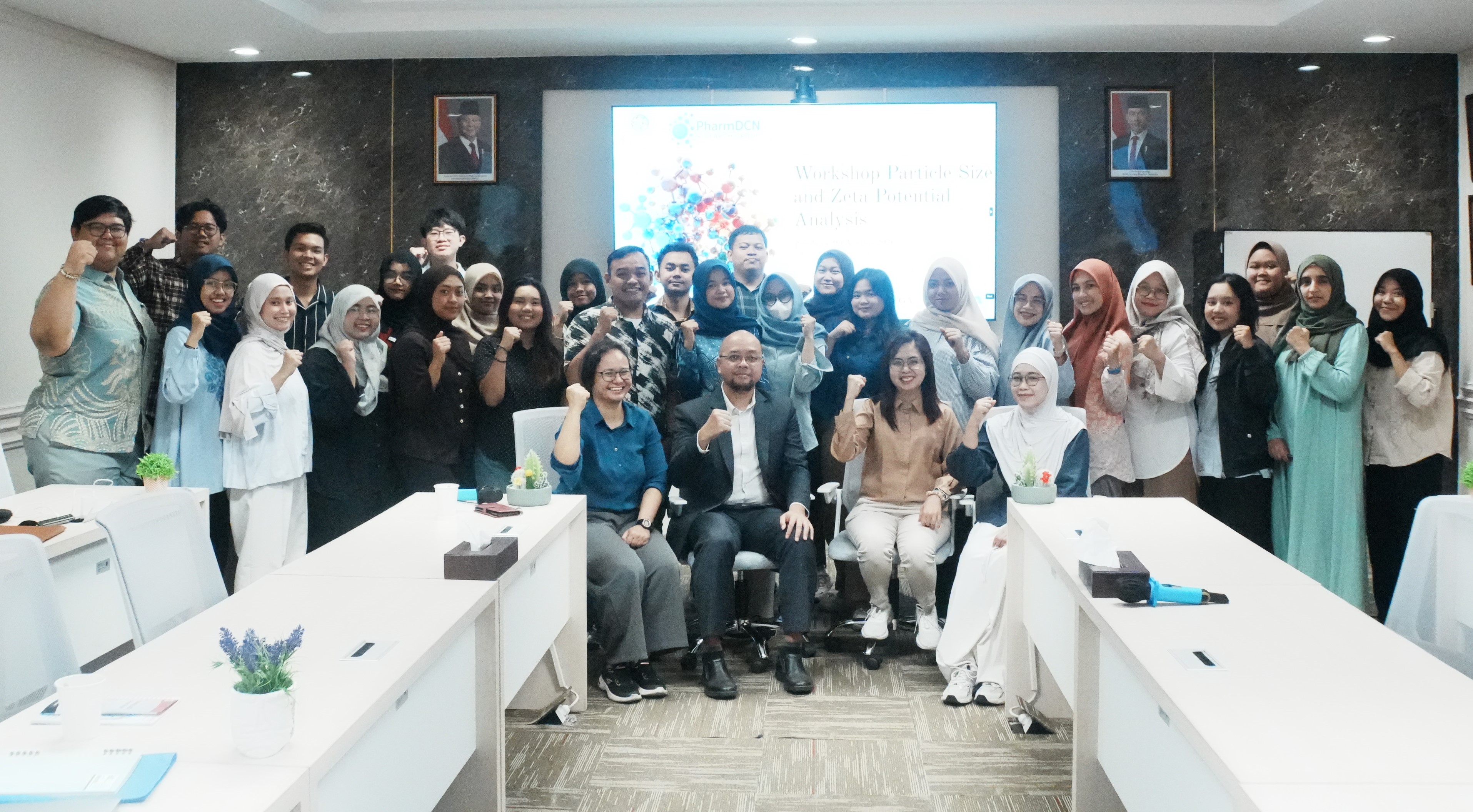
FF UNAIR through the Research Group (RG) Pharmaceutics and Delivery Systems for Drugs, Cosmetics, and Nanomedicine (PHARM-DCN) in collaboration with PT. Almega Sejahtera and Horiba held a Workshop on Particle Size Analysis and Zeta Potential. This activity, held on Wednesday (August 5), was attended by 38 students from Bachelor’s, Master’s, and Doctoral Programs at FF UNAIR as part of efforts to enhance competencies in the field of nanoparticle-based drug delivery system characterization.
The workshop was formally opened by Prof. apt. Helmy Yusuf, S.Si., M.Sc., Ph.D., Vice Dean I of FF UNAIR and also Chair of the PHARM-DCN Research Group. In his remarks, he stated that understanding nanoparticle characterization techniques is one of the important competencies in supporting the development of modern pharmaceuticals research, particularly in drug, cosmetic, and nanomedicine formulations.
This activity aimed to provide students with a more comprehensive understanding of nanoparticle examination concept using dynamic light scattering (DLS) principles for particle size analysis, as well as zeta potential measurement as an important parameter in predicting the physical stability of nanoparticle preparations. The material presented not only discussed basic theory but also the application of these characterization techniques in research and pharmaceutical product development.
After attending the theory session, participants had the opportunity to participate ina hands-on session in laboratory MPL 5, using the particle size analyzer and zeta potential instrument from Horiba. During this practical session, participants conducted sample preparation,instrument operation, and interpretation of measurement results directly with guidance from the speakers and technical team.
Through this activity students were expected not only to obtain conceptual understanding but also practical experience in the use of analytical instruments widely utilized in pharmaceutical and nanotechnology research. This competency is expected to support the quality of student research while increasing their readiness to face technological developments in the pharmaceutical fields.
The cooperation between FF UNAIR, PT. Amerga Sejahtera, and Horiba also represented a strategic step in strengthening synergy between higher education and industry. This collaboration is hoped to continue developing through various educational activities, training, and joint research capable of supporting the improvement of human resources quality and innovation in pharmacy and nanomedicine.
The particle size analysis and zeta potential workshop activity supports the achievement of SDGs, particularly SDG 4 (Quality Education) through enhancing student competencies with theory and practice-based learning using high-technology instruments. Additionally, this activity also contributes to SDG 9 (Industry, Innovation and Infrastructure) by strengthening research and innovation capacity in drug delivery systems and nanomedicine. The collaboration between FF UNAIR, PT. Almega Sejahtera, and Horiba also reflect the implementation of SDG 17 (Partnerships for the Goals) through synergy between higher education and industry in supporting the development of sustainable education, research, and innovation.


